


Supply chain was top of mind in the last couple of months, both strategically (what do we purchase and from whom, what do we build/run in house?) as well as tactically (what kind of impact will tariffs have?) for everything from raw materials to finished parts. The tactical stuff is limited in direct impact for now and mostly shows up in increased costs, but we are fairly insulated so far based on the state as of 3 minutes ago...
We were able to move into our new facility much faster than originally planned (March instead of July), which helped us massively in getting everything set up for manufacturing and testing beyond what we would have been able to fit into our old space. We have some more buildout to complete (clean room mostly), but expect to have that all wrapped up in the next couple of weeks.
Odin't

This March saw AstroForge's first mission to a near Earth asteroid. They had scoped a flyby to take photos of an asteroid with their spacecraft called Odin. The title links to their mission debrief, which provides some context about what went wrong and what lessons they have been able to draw from that.
The spacecraft was basically launched on a ballistic trajectory away from Earth without ever connecting with ground stations, which makes real root cause analysis impossible. From the overview AstroForge provided it sounds like a significant portion of the issues stem from insufficient integrated testing with the ground station providers. These companies, who sell antenna access/time by the minute, have some antennas that they own and operate as well as a wide range of partners that all use different equipment and systems.

The main spacecraft on the launch that also carried the AstroForge mission was a lunar lander designed and built by Intuitive Machines. They launched a lander last year which ended up tipping over, at least in part because of faults in their range finding system. Their IM-2 mission sadly ended up on its side as well, with the laser range finder as one of the expected culprits.

On a brighter note, this image from Firefly showing their Blue Ghost lander on the surface of the moon is pretty epic. First attempt, very impressive!
High Frontier Mission Update
Our primary mission objective is:
To rendezvous with an uncharacterized near-Earth Asteroid and showcase capturing regolith at kilogram scale, minimizing mission duration and cost.
Budgets
We track our mass, financial, power and delta-v budgets in great detail as design drivers for our mission. Mass and delta-v are closely related and would normally work in tandom (mass goes down, delta-v goes up), but last quarter showed that move in the other direction. The main reason here is a more conservative calculation of margins and unusable fuel, which feels more appropriate given what we've learned about the propulsion system we selected.
Mission Design
Our target leaderboard is directly impacted by the delta-v we have available for the mission, because it drives if/when we can reach a certain target. We showed our current 'favorite' 2022 DC5 last quarter, an asteroid that combines a lot of things that we like.
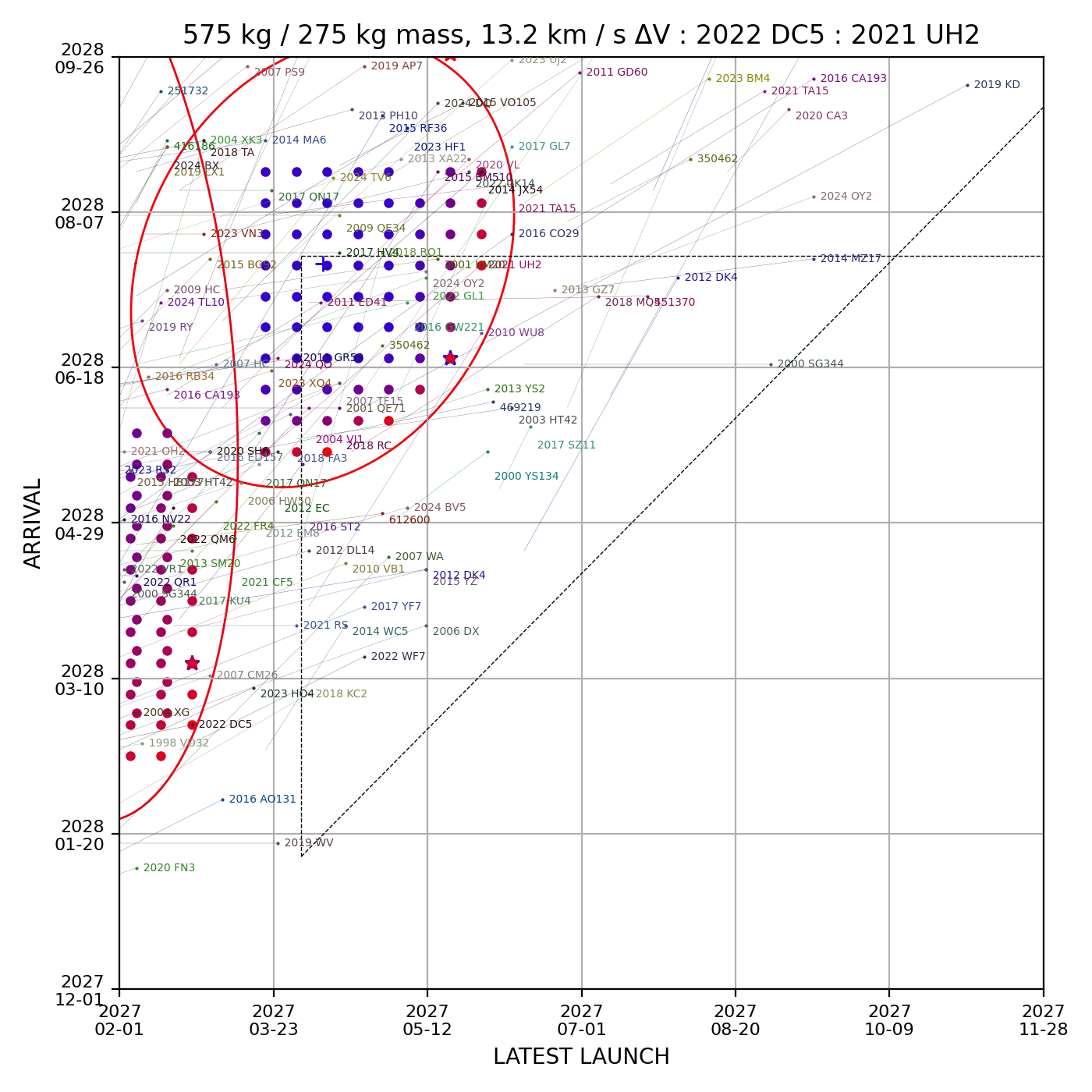
The plot above shows the impact of launch time (we are riding on SpaceX Transporter 19, which can launch anywhere from early Feb 2027 through the summer of that year) and delta-v for different targets. The plot shows 2022 DC5 as well as a runnerup target called 2021 UH2, including their relative delta-v requirements and expected mission duration. If we launch early in our window, 2022 DC5 is the clear winner and should also be reachable faster, with a smaller amount of delta-v. There is a clear drop though, at which point it is no longer possible for our spacecraft to reach that target at which point the likely frontrunner becomes 2021 UH2.
When we launch is a major driver for this targeting decision and it is something we have no control over. Our approach gives us resilience to 'missing the window' while ensuring that we have targets we can reach that we like enough.
Visualization of our orbit from launch into SSO and spiraling out of Earth's gravity well
The video above shows the first phase of the mission, from launch through Earth escape. We launch into a sun synchronous orbit with an altitude of about 550 km, but need to leave Earth's gravity well entirely which requires us to get beyond ~50,000 km before we are in deep space.
The most effective/affordable option available is called a spiral out, in which we gradually raise our orbit over several months. We are trading speed/time against cost in this case, a much more expensive launch to GTO would cut the time to spiral to Earth escape by several months but would put us on a much less reliable schedule with a cost base that we don't believe is sustainable.
Spacecraft
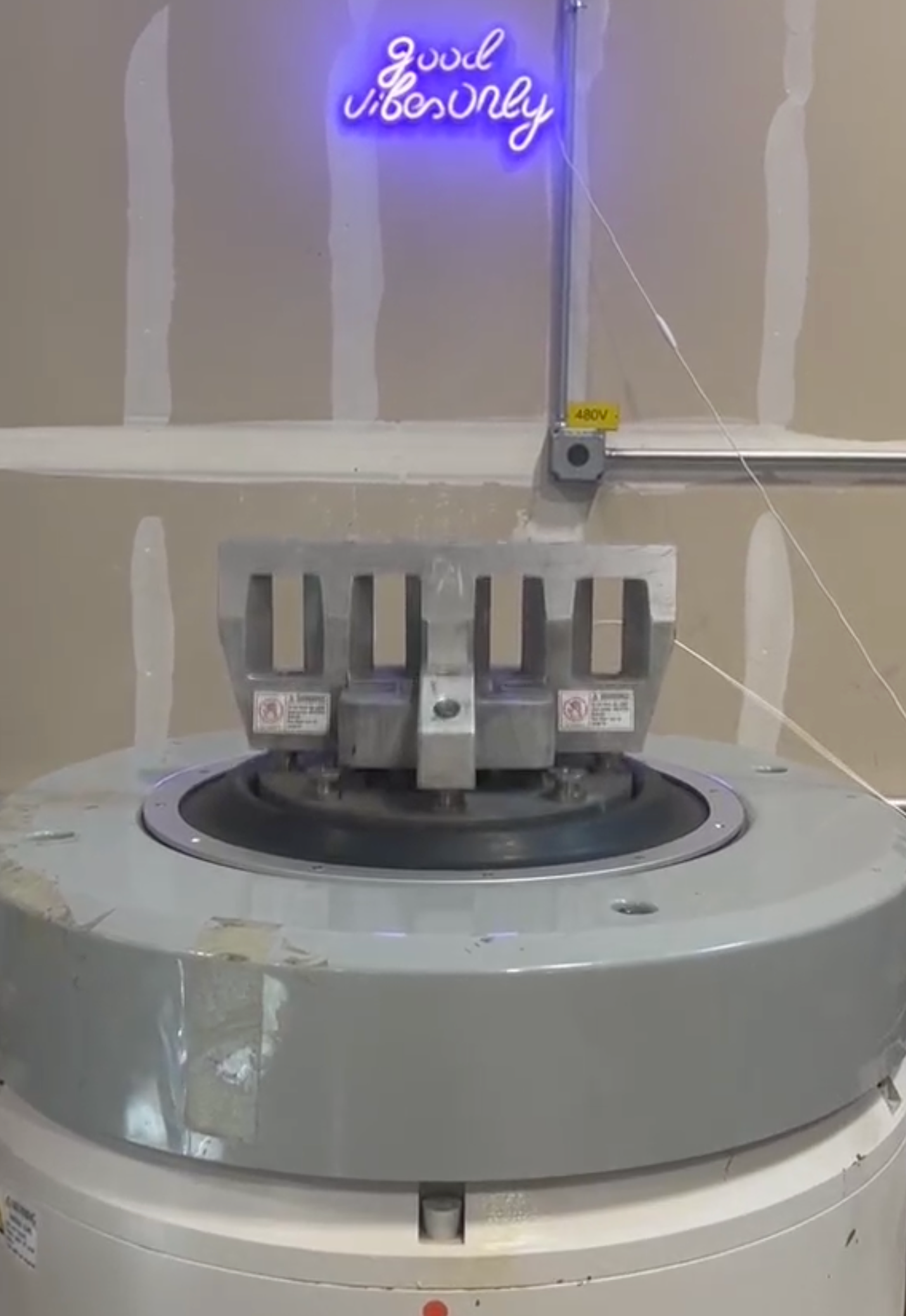
When we moved to in house manufacturing of our spacecraft last year, it also became clear that we would need to have our own testing capabilities across thermal, TVAC and vibration to ensure a rapid feedback loop and to make sure we control that portion of the work on our end. This setup allows us to rapidly develop and iterate, while also running our own qualification campaigns for components and parts that we develop.
The fully integrated tests of our spacecraft (sized at about half of a small car with the solar arrays folded for launch) will likely be outsourced given the scale required for that kind of test campaign. That portion of the testing has limited impact on timelines and speed of development though, which made for a clear break between in house and outsourced work.
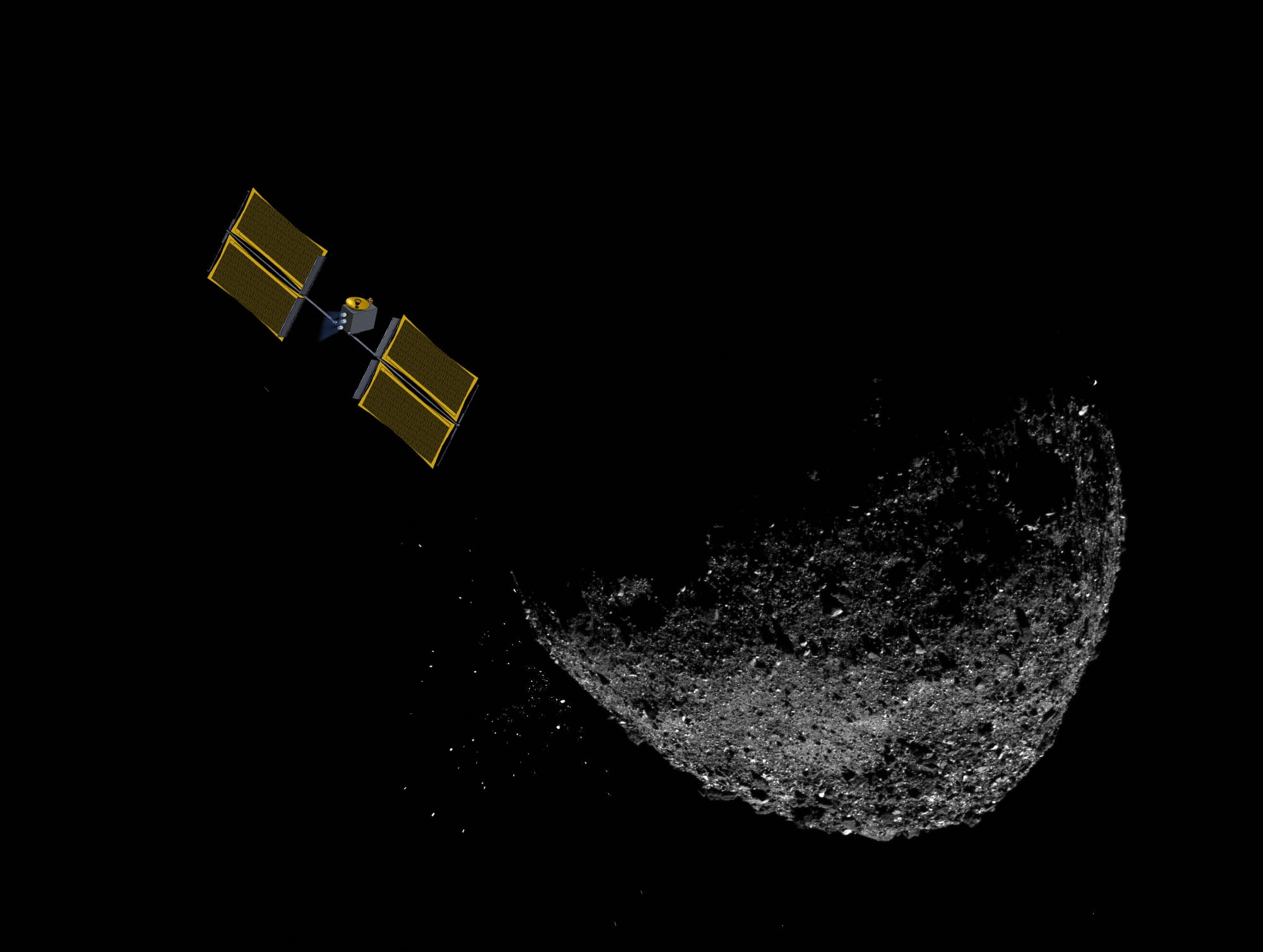
Looking at our current spacecraft design, we are basically flying a giant fuel tank with solar arrays. Our dry mass (excluding fuel) is ~300 kg, so we are carrying more fuel than anything else during launch. Looking at the mass fractions for that 300 kg, about 1/3 is propulsion (tank, thrusters, power systems for the thrusters and relevant plumbing), 1/3 is power (solar arrays & batteries) and the last 1/3 is everything else.
In figuring out the split between in house and outsourced, we always start looking at the availability of parts in the market to get a baseline understanding of what is available. That is a mixture of performance, schedule and cost that in many cases already clearly points us in a certain direction.
The solar arrays we need to be able to power our propulsion system are massive giving us a total deployed wingspan of ~4 x 18m, but we also need them to be very mass efficient. This ratio of W/kg is one of the main drivers for the system, with industry ranges well outside of what we needed to make this work successfully. Our internally developed boom and deployment structure will (if it all works...) be the most mass-efficient solar array ever flown. That power density matters a lot to us for both this and future missions.
These trades across the various components and systems have allowed us to focus strategically when it comes to things that we are developing in house. In other cases, we are purchasing a product available in the market (sadly at market prices, but that alone is generally not a reason to bring work in house).
As an easy comparison, our current budget of ~$17M for the mission with a launch in Feb of 2027 would balloon into ~$40M with a launch in 2028 if we purchased the cheapest/fastest market options for the various items we brought in house. We will expand this going forward to bring that cost down even more.
Excavation
We showed some images last quarter for one of our excavators, which we were testing in a box full of Orbeez. Orbeez are interesting because they are neutrally buoyant, providing a surface tension and structure that comes quite close to some of the surface conditions we expect to find in the micro-gravity environment of an asteroid.
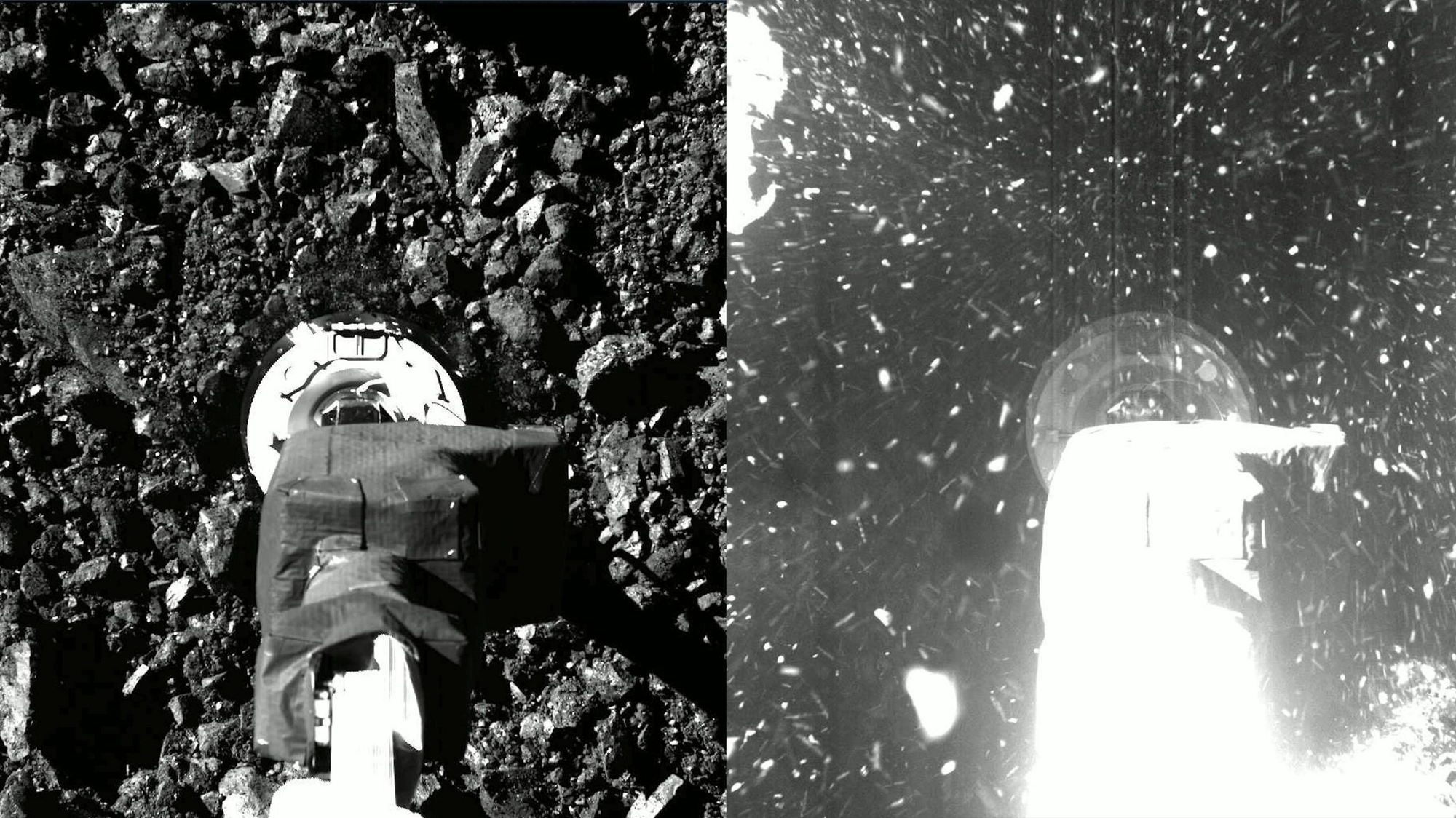
Those early tests have gone through several iterations in the last couple of months as we refined the idea of using buoyancy to mimic digging into an asteroid. Based on the surface interactions observed during the JAXA Hayabusa2 and the NASA OSIRIS-REx mission we expect to find a 'rubble pile'. This loosely held (effectively no gravity, so very low cohesion) agglomeration of fines, pebbles and rocks does not show much if any ability to clump together.
Running full scale tests would require us to both create the rocks and pebbles (lots of work, but doable) as well as turn off gravity (much, much harder). The existing solutions for microgravity testing are drop towers (very brief period of micro gravity measured in single digit seconds) or vomit comet flights (slightly longer and more gradual with a 20-30 second window) that each have their own issues.
We need the material to 'settle' and interaction to be slow before we interact with it to avoid test data showing fluid dynamics more than the micro gravity setup we are going for. We also want to run the tests at 1:1 scale which is larger than you can fit into the 'test box' available, especially because we also need this undisturbed pile of asteroid regolith to work with.
The latest iteration of our excavation test bed brings all of those aspects together into the best example we've been able to create of an asteroid without effective gravity here on Earth.
We started with a much larger tank (~1m cubed) which we filled with water and clear Orbeez (bottom half of the tank, so several hundred billion of them). With that base to work with, we started casting neutrally buoyant 'rocks' using epoxy in a wide range of sizes and shapes. These rocks float on and in the layer of Orbeez and provide our excavator with a clear target to try and grab.
The video above showed one of the first tests we ran, with a submersible version of our Pokeball excavator. The mechanism and tolerances clearly still need work and will be much stronger/tighter in our next iterations, when we move into metal versions with the motors we expect to use in the flight model.
Circling back to our mission goal, we want to capture kilogram scale amounts of regolith on this first mission. The smallest pebbles shown are about 1/4 of a kilogram, the larger ones would weigh 1-2 kilograms each based on their volume. Based on the testing we've been able to run with this new setup, we're seeing a range of 5-15 kg of material excavated with 'one bite'.
As you can also see in the videos, we typically lose a fair bit of material as we ascend away from a touch and go event. This is due in part to the materials we're using (the 3d printed bucket scoops lose out to the epoxy rocks strength-wise, so it is very easy for things to get stuck and keep the system open. Our metal/flight versions will be equiped with 'lose your finger' titanium scoops that have sharp edges to crush and bite through rock, as well as the motor strength to chew through the range of material we expect to find.
Our other excavator called Micro Squid uses a compliant 'soft gripper' that is covered in micro spines to effectively work as a gecko claw. It can fold itself around any larger rocks that we encounter which would not fit into Pokeball and uses its spines to lift things that far outweigh anything that we could grab otherwise.
While this is much harder to test on Earth, we are using a scale in this test bed which allows us to measure how much force we are placing on the rock itself. Its actual performance/capability will really only be visible at the asteroid because it is much harder to offload gravity in this regard, but our testing shows an ability to pick up rocks that weigh 30kg in a 1G environment. If we translate that to what we expect to find at the asteroid, we should be able to grapple 1m diameter rocks that weigh over 1,000 kg. The limiting factor in this case is the reaction control system of our spacecraft which provides the thrust needed, more than the excavator itself.
Regolith Age
Our core idea of the regolith age starts with the lowest hanging fruit, extracting water (as the most useful consumable in orbit) from the hydrated clay minerals. There are several steps hidden in that statement, which we are currently working on to test out the most effective methods. We have a high-powered spacecraft because our whole system is built to run our 4.5 kW Hall effect thruster system, which gives us ample spare power to work with at the asteroid when that is not being used.
The simplest version of what we are trying to do is the following schema:
Regolith -> Processor -> H2O + Regolith Tailings
A more elaborate versions starts the same, but adds several additional steps:
Regolith -> Processor -> H2O + Regolith Tailings -> Splitter -> O2 + H2 -> Liquifier -> LOX + LH2
That 'Processor' step requires moving regolith around, compacting and crushing, heating to a sufficient level to boil out the water, separating the water in a cold trap and discarding the tailings to allow the system to run again. We want the system to run as efficiently as possible (getting water out of 'crushed' regolith is easier than from a range of different agglomerations) and this system will clearly also need to work in micro gravity.
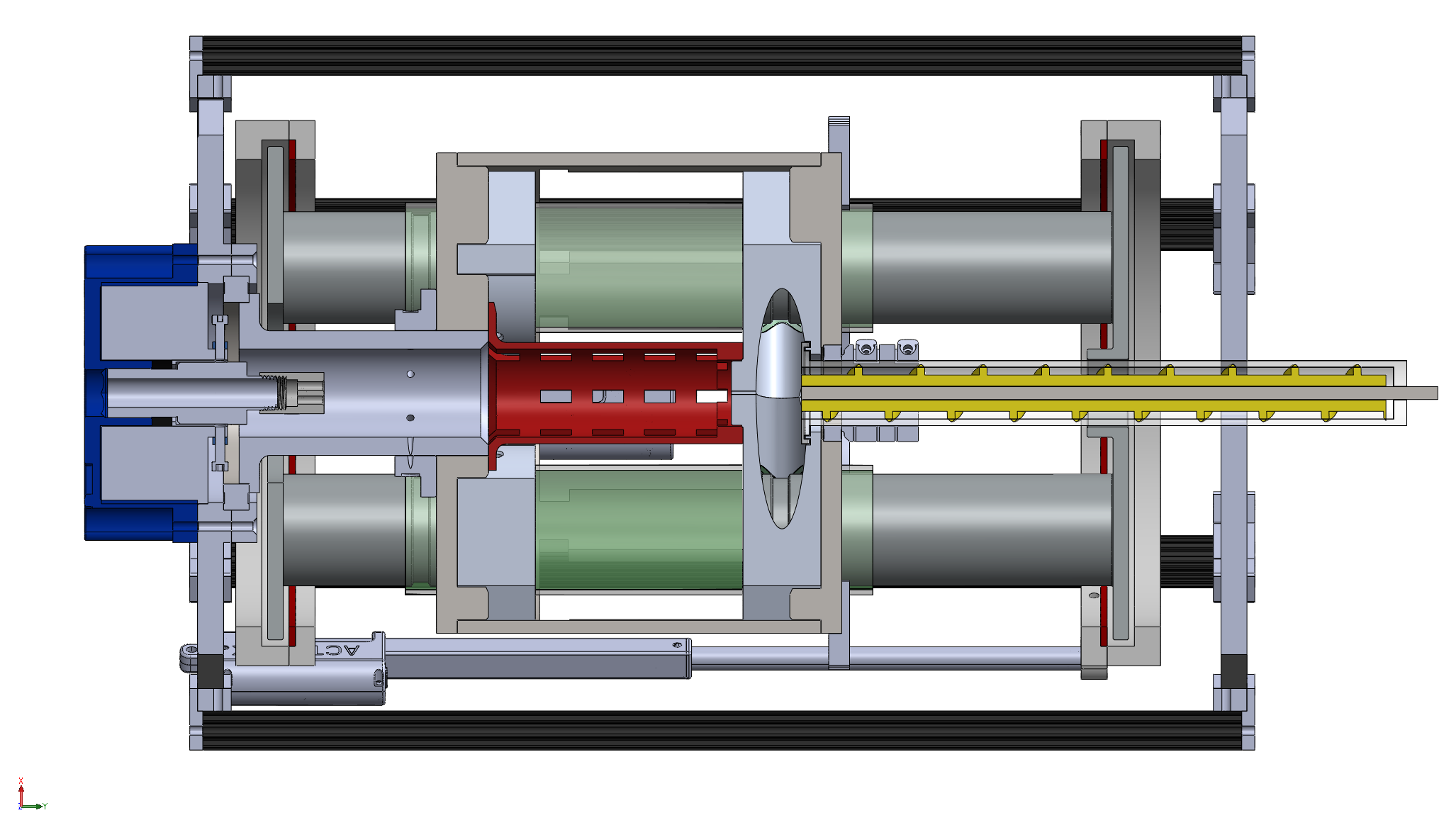
Liquid oxygen and liquid hydrogen as well as the methane that you can make by adding carbon are the fuel for rocket engines, while water can be used as a fuel directly by a smaller subset of spacecraft. The water itself, as well as the tailings which are newly dessicated clays, are important feed stocks for space station operations. The tailings/clay portion (~90% of the material we extract) can be used as shielding material against radiation, micro meteoroids and space debris.
Our Q1 2025 Goals:
We made some progress here across avionics and GNC, but still have a lot more to build out in the coming months.
This remains a work in progress that will carry over into Q2/Q3.
Our Q2 2025 Goals:
Thanks for joining us on this adventure!
The Karman+ Team